
Our Peer Review Process
ConfSeries is committed to maintaining a fair, rigorous, transparent, and constructive peer-review process. Every submitted manuscript is evaluated according to the scope, standards, and editorial policies of the respective journal.
Peer review helps assess the originality, scientific quality, methodological soundness, relevance, clarity, and ethical integrity of submitted research before publication.
Peer Review Model
ConfSeries Journals follow a single-anonymized peer-review model. Reviewers are provided with the authors' identities and affiliations, while reviewer identities are not disclosed to authors.
Manuscripts are evaluated independently by reviewers with relevant subject expertise. Editorial decisions are based on the quality, originality, relevance, methodological soundness, and ethical standards of the submitted work.
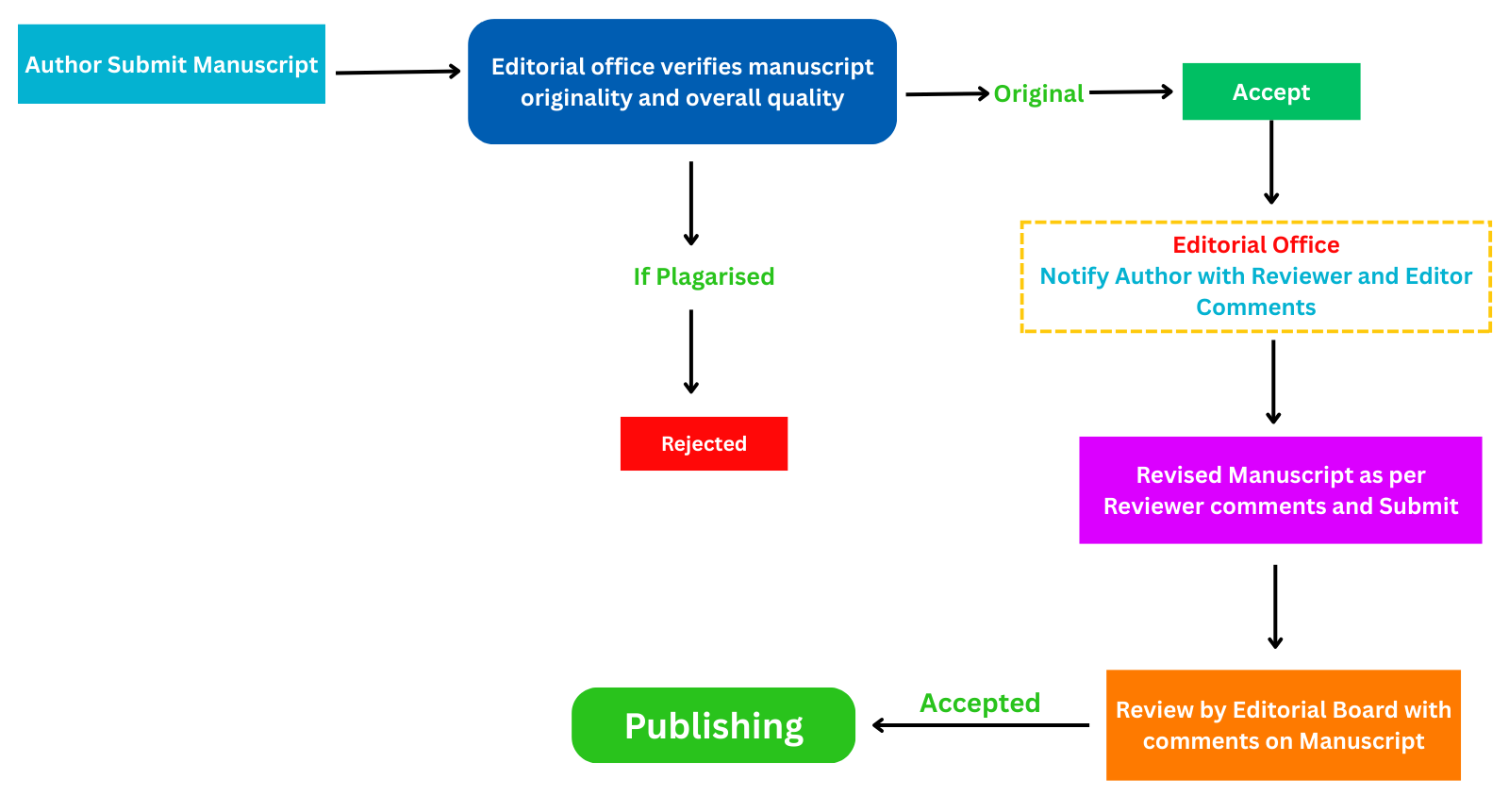
STEP 1: MANUSCRIPT SUBMISSION
Authors submit manuscripts through the ConfSeries submission platform in accordance with the manuscript preparation guidelines and requirements of the respective journal.
Submission of a manuscript indicates that the authors agree to comply with the applicable journal policies and confirm that the manuscript is suitable for consideration by the journal.
STEP 2: INITIAL EDITORIAL SCREENING
Each new submission undergoes an initial editorial assessment to determine whether it meets the basic requirements of the respective journal and is suitable for further consideration.
The initial screening may include the following checks:
- Relevance to the journal's aims and scope
- Completeness of the required submission documents
- Compliance with the journal's formatting and submission guidelines
- Originality and potential plagiarism concerns
- Ethical, legal, and research integrity considerations
Manuscripts that do not meet essential submission, ethical, originality, or journal requirements may be returned to the authors for clarification or correction, or may be rejected when the concerns cannot be resolved. Suitable submissions proceed to the next stage of the peer-review process.
STEP 3: EDITORIAL ASSIGNMENT
Following the initial editorial screening, a handling editor is assigned to oversee the manuscript through the peer-review process. The handling editor evaluates the suitability of the manuscript for external review and coordinates the review process.
STEP 4: REVIEWER SELECTION
Reviewers are selected according to their relevant subject expertise, research experience, academic qualifications, and suitability for evaluating the submitted manuscript.
Reviewers are expected to be independent of the authors and to disclose any potential conflict of interest that could affect the objectivity of their assessment. Additional reviewers may be invited when a manuscript requires further specialist evaluation.
STEP 5: REVIEWER ASSESSMENT
Reviewers evaluate manuscripts according to the requirements and scope of the respective journal. The assessment may consider:
- Originality, novelty, and relevance
- Scientific or scholarly contribution
- Research methodology and study design
- Data analysis and interpretation
- Accuracy and validity of results and conclusions
- Use and relevance of supporting literature
- Clarity and organization of presentation
- Ethical and research integrity considerations
Reviewers provide constructive comments and recommendations to assist the editor in reaching an informed editorial decision and, where appropriate, to help authors improve their manuscript.
STEP 6: EDITORIAL DECISION
After considering the reviewer reports and the overall quality of the manuscript, the handling editor makes an editorial decision in accordance with the journal's policies and scope.
Depending on the outcome of the evaluation, the manuscript may receive one of the following decisions:
- Accept: The manuscript is suitable for publication without further substantive revision.
- Minor Revision: Limited changes are required before the manuscript can be considered for acceptance.
- Major Revision: Substantial revisions are required and the manuscript may require further evaluation.
- Reject: The manuscript is not suitable for publication in the journal based on the editorial and peer-review assessment.
Editorial decisions are based on the scholarly quality and suitability of the manuscript and are not determined by the ability or willingness of an author to pay any applicable publication charges.
STEP 7: AUTHOR REVISION AND RE-EVALUATION
When revisions are requested, authors should submit a revised manuscript together with a point-by-point response explaining how the reviewer and editorial comments have been addressed.
The revised manuscript is evaluated by the handling editor and, where necessary, may be returned to the original reviewers or additional reviewers for further assessment.
Authors may be asked to provide further revisions when the editor determines that additional changes are necessary before a final decision can be made.
STEP 8: FINAL ACCEPTANCE AND PUBLICATION
Once a manuscript has successfully completed the peer-review and editorial process and has been formally accepted, it proceeds to the final publication stage.
The accepted manuscript may undergo copyediting, formatting, reference and metadata checks, and other publication preparation procedures to ensure that the final version meets the journal's publication standards.
Where applicable, authors may be asked to review the final publication-ready version before online publication. Following completion of the publication process, the article is published online and becomes part of the journal's scholarly record.
Ethical and Editorial Integrity
ConfSeries is committed to:- Fair and unbiased peer review
- Confidential handling of submissions
- Ethical oversight at all stages
- Transparent communication with authors
Our editorial and review processes are conducted in accordance with established ethical publishing practices, aligned with the principles of the Committee on Publication Ethics (COPE).