
Background: Stress is a complex and interdisciplinary phenomenon defined as a dynamic relationship between an individual and their environment that is perceived as exceeding personal resources and threatening well-being. While commonly understood as a state of psychological tension caused by difficult life situations, stress also serves an adaptive function by mobilizing physiological and psychological resources. In moderate intensity it may enhance motivation and cognitive performance; however, prolonged exposure leads to dysregulation and adverse health outcomes. From a scientific perspective, stress operates at the intersection of psychology, biology, and social sciences, involving cognitive appraisal processes, neuroendocrine responses, and environmental influences.
Objectives: The objective of this narrative literature review is to present current interdisciplinary knowledge on stress, its underlying mechanisms, health consequences, and strategies for regulation. The review synthesizes contemporary theoretical models of stress, biological and psychological pathways of the stress response, and evidence on short- and long-term coping strategies.
Methodology: The methodology is based on a structured narrative review of peer-reviewed scientific literature from international databases, including empirical studies, theoretical frameworks, and high-impact review articles published in recent years. The analysis integrates findings from psychology, neuroscience, and behavioral medicine to ensure a comprehensive conceptual perspective.
Key findings: The reviewed evidence demonstrates that chronic stress significantly affects cardiovascular, immune, metabolic, and nervous system functioning, and increases the risk of mental health disorders such as anxiety, depression, and burnout. Effective stress regulation relies on both immediate techniques, such as relaxation and breathing exercises, and long-term strategies including lifestyle modification, cognitive restructuring, and social support. Individual differences and environmental conditions play a critical role in shaping stress responses and coping effectiveness.
Conclusions: In conclusion, stress should be understood as a multidimensional process with both adaptive and maladaptive potential. Promoting evidence-based coping strategies and psychological resilience is essential for protecting health and improving quality of life at both individual and population levels.
Keywords: Stress; Chronic Stress; HPA Axis; Coping Strategies; Allostatic Load; Neuroendocrinology of Stress, Psychological Resilience; Interventions; Emotion Regulation
Stress is defined as a relationship between an individual and the environment that is perceived as exceeding one’s coping resources and threatening one’s well-being. In popular terms, “stress” refers to a state of psychological tension caused by a challenging life situation [1]. At the same time, stress constitutes a natural adaptive mechanism that mobilizes the organism when experienced in moderate amounts, it can enhance concentration and motivation (eustress), however, its chronic persistence leads to dysfunction (distress). From a scientific standpoint, stress lies at the intersection of psychology (cognitive appraisal and emotional responses), biology (neurohormonal reactions and the nervous system), and social determinants (environmental influences and cultural burdens) [2]. International health organizations emphasize that excessive stress adversely affects both physical and mental health, while stress management skills are crucial for maintaining well-being [3,4].
The aim of this literature review is to present, in a systematic manner, the current state of knowledge on stress and its regulatory mechanisms. This includes an overview of definitions and theoretical models of stress, biological and psychological mechanisms of the stress response, consequences of chronic stress, and both short and long-term coping strategies.
Although stress has been extensively examined within psychology, neuroscience, and public health, existing reviews typically address these domains in isolation. The novel contribution of the present review lies in its explicit interdisciplinary synthesis, integrating classical and contemporary stress models with neurobiological mechanisms (HPA axis, allostasis), psychological regulation processes, and population-level public health and psychoeducational perspectives. By linking individual neuroendocrine stress responses with broader environmental, occupational, and educational contexts, this review moves beyond a descriptive overview and provides a translational framework that connects biological mechanisms with applied stress regulation strategies relevant for public health practice and prevention.
This paper adopts the format of a narrative literature review conducted in accordance with academic methodological standards applied in interdisciplinary research on the interface of health psychology, neuroscience, and behavioral medicine. The selection of source material was based on a purposive and systematic search of reputable databases such as PubMed, APA PsycInfo, Google Scholar, and ScienceDirect, employing precise logical operators (AND, OR) and keywords associated with terms including: stress, chronic stress, HPA axis, coping strategies, allostatic load, neuroendocrinology of stress, psychological resilience, interventions, and emotion regulation.
The analysis considered both primary sources, comprising empirical studies (experimental, longitudinal, cross-sectional, and meta-analytical), and secondary sources, including review articles, institutional research reports, and highly cited theoretical works (e.g., Selye, Lazarus, McEwen). Complementarily, monographic and textbook literature of foundational and academic character was used to establish conceptual and terminological grounding of the discussed issues. Special attention was given to Stresoanulator by Grajek and Jurys, treated as a conceptual document in psychoeducation, acknowledging its translational character bridging expert knowledge and psychological practice. Stresoanulator by Jurys and Grajek was included as a supplementary psychoeducational resource rather than as empirical evidence. Its role in this review is translational: it exemplifies how established scientific knowledge on stress mechanisms and regulation strategies can be operationalized into structured psychoeducational tools. The publication is therefore used to illustrate practical application of evidence-based concepts, clearly distinguished from primary research findings.
Inclusion criteria encompassed publications indexed in peer-reviewed scientific journals, published after 2015, available in English or Polish, and meeting methodological standards concerning sample transparency, research procedures, and statistical analysis. Priority was given to studies demonstrating a direct causal relationship between stress and health outcomes or the effectiveness of adaptive interventions. Excluded from the review were popular science publications, speculative materials, and articles lacking full methodological transparency. The initial database search yielded approximately 420 records. After removal of duplicates and preliminary title and abstract screening, 185 publications were assessed for full-text eligibility. Following application of inclusion and exclusion criteria, a total of 25 sources were included in the final synthesis. The screening process prioritized methodological quality, relevance to stress mechanisms or interventions, and interdisciplinary applicability. This approach ensured a balanced representation of empirical evidence, theoretical models, and high-impact reviews.
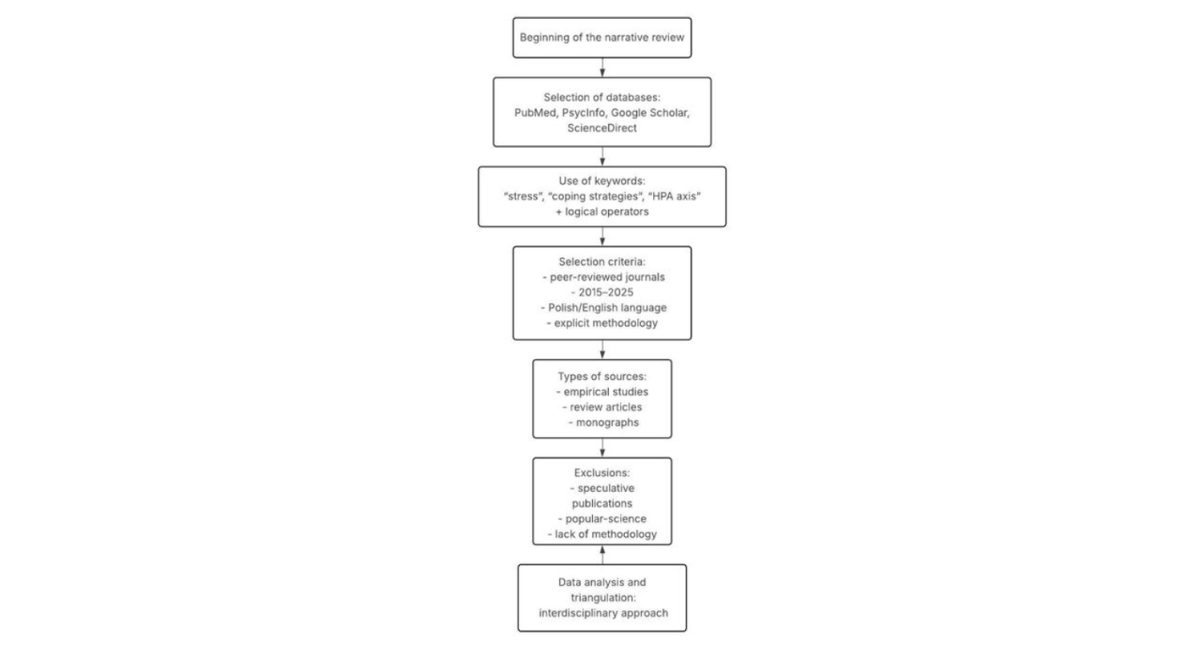
Figure 1: Methodology
Several classical conceptualizations of stress have been identified in the literature. Hans Selye, a pioneer in stress research, described the General Adaptation Syndrome as a sequence of three phases of the organism’s response to threat: alarm, adaptation (resistance), and exhaustion [5]. These phases illustrate Selye’s model: the first (alarm) phase initiates rapid physiological mobilization, the second maintains adaptation during prolonged stress, and the third (exhaustion) emerges under chronic overload, posing risks to health integrity [5]. Another influential framework is the transactional model by Lazarus and Folkman, which posits that stress results from an individual’s subjective appraisal (primary and secondary) of the situation stress occurs when perceived demands exceed perceived resources [6].
From a physiological perspective, Walter Cannon introduced the concept of the “fight-or-flight” response as a primary defensive mechanism triggered by the amygdala and the HPA (hypothalamic–pituitary–adrenal) axis [7]. Occupational psychology frequently refers to the Yerkes–Dodson curve, which describes that performance increases with arousal up to an optimal point, after which excessive stress impairs efficiency (the so-called inverted-U function) [8]. Additionally, the literature distinguishes eustress (positive, mobilizing stress) from distress (negative, chronic, and destructive stress) [5].
The stress response engages both the nervous and endocrine systems. The amygdala detects threat signals and in fractions of a second activates the hypothalamic–pituitary–adrenal (HPA) axis along with the sympathetic branch of the autonomic nervous system [5]. As a result, the adrenal glands release adrenaline and noradrenaline, accelerating heart rate, respiration, and muscle tension. Cortisol, often termed the “stress hormone,” sustains this state of mobilization by maintaining elevated blood glucose levels, though prolonged elevation leads to immune suppression and metabolic disturbances [5,9].
Neurobiological findings show that chronic stress induces neuroplastic changes in the brain - such as remodelling of dendrites and synapses in limbic and cortical areas involved in memory, emotion, and decision-making [10]. Consequently, neural circuits regulating memory, anxiety, and mood become dysregulated, manifesting in cognitive decline and emotional instability [11]. Initially adaptive in nature (supporting allostasis), these changes can become pathological when prolonged and consolidated, necessitating clinical intervention [11].
Psychological mechanisms including cognitive appraisal (primary and secondary) and coping processes modulate the subjective experience of stress. The literature highlights the role of self-regulatory strategies (e.g., mindfulness, controlled breathing) in attenuating the alarm response [12]. Individual factors such as temperament, early childhood experiences, biological sex, and genetic predispositions also modulate stress reactivity via epigenetic and hormonal pathways [11].
While the association between chronic stress and neurobiological alterations is well documented, the literature reveals variability in effect sizes and methodological approaches. Differences in study design, stress operationalization, and population characteristics contribute to inconsistent findings regarding the reversibility of stress-induced neural changes. Many studies rely on cross-sectional designs or self-reported stress measures, which limits causal inference. These methodological constraints highlight the need for longitudinal and multimodal research integrating biological markers with psychological and environmental data.
Chronic stress exerts widespread effects on both somatic and mental health. From a physiological perspective, its consequences include:
Psychologically, chronic stress predisposes individuals to anxiety and depressive disorders. Numerous studies confirm that people experiencing sustained stress loads report higher anxiety, low mood, and fatigue [13]. Chronic tension also promotes occupational burnout characterized by emotional exhaustion and cynicism at work. Neurologically, imaging studies reveal stress-related hippocampal volume reduction and altered prefrontal cortex activity, explaining observed deficits in memory and concentration [17]. Consequently, executive functions and emotional regulation deteriorate, while the body remains in a state of chronic allostatic load [11,13].
Stress management techniques can be categorized into immediate relaxation interventions and long-term, proactive resilience-building strategies.
Coping strategy selection should reflect individual preferences and life circumstances. Maladaptive responses involving avoidance, alcohol use, or excessive rumination- exacerbate stress impact [19,24]. Conversely, consistent use of adaptive techniques (both physical and cognitive) correlates with lower stress levels and higher quality of life [5,19].
Although numerous coping strategies demonstrate beneficial effects, their effectiveness is not universal. Evidence suggests that intervention outcomes depend on individual differences, contextual factors, and sustained implementation. For example, mindfulness-based techniques show moderate to strong effects in motivated individuals, while task-focused strategies appear more effective in occupational stress contexts. This variability underscores the importance of tailoring stress management interventions rather than promoting uniform solutions.
Stress reactivity is shaped by a complex interplay of biological, psychological, and social factors. On the individual level, genetic and developmental determinants such as polymorphisms in HPA-axis–related genes, early-life trauma, or attachment style have long-term effects on stress resilience [25]. There are also notable sex differences in neurochemical pathways mediating stress responses [11]. Individuals differ in perceived control and coping style; those with high psychological resilience exhibit greater cognitive flexibility and more frequent use of adaptive strategies [26].
Environmental factors include socioeconomic and psychosocial burdens. Chronic exposure to stressful settings- high job demands, low autonomy, job insecurity, poverty, or family conflict accumulates stressors and increases overload risk. In contrast, social and community resources (e.g., friendship networks, neighborhood support) serve as buffers, mitigating the health impact of stress by enhancing perceived safety and belonging [27].
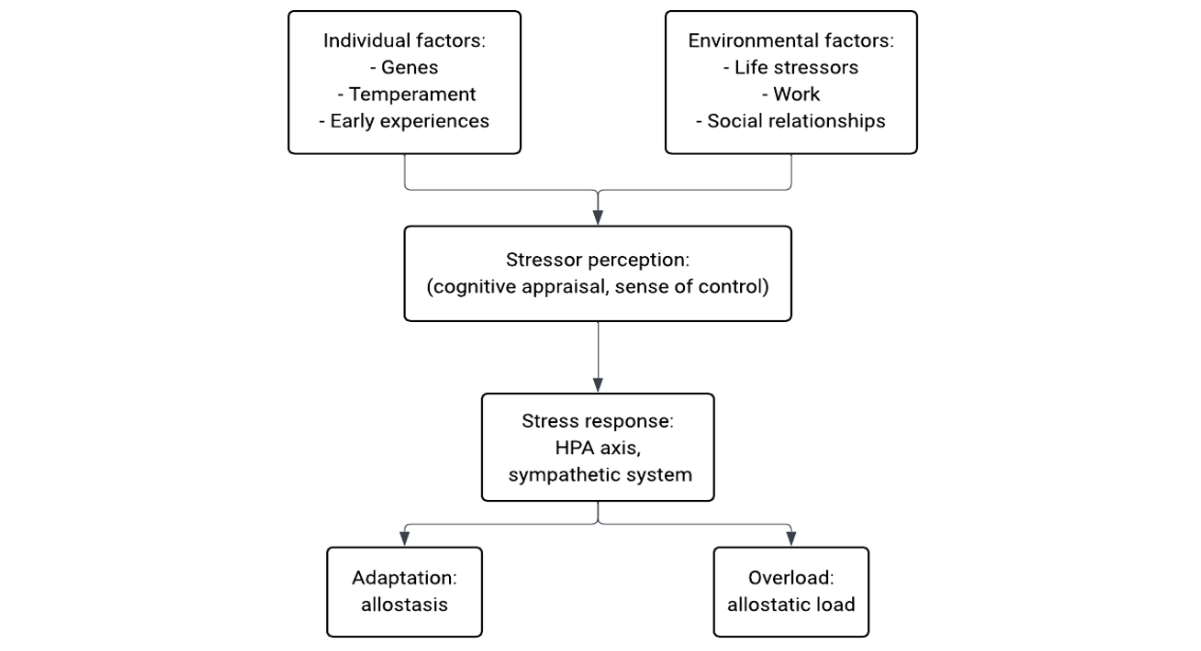
Figure 2: Schema of interactions between individual and environmental factors in the stress response [11]
Figure 2 illustrates the relationships between external factors (life stressors, work, interpersonal relationships) and internal individual determinants (genetic factors, past experiences), as well as their influence on stress perception and the resulting physiological adaptation (allostasis) or overload. According to the concept of allostasis, the organism maintains stability through adaptive change; however, chronic load leads to cumulative negative effects, referred to as allostatic load [11].
The literature review demonstrates that stress is a complex, multidimensional phenomenon, biologically linked to HPA axis and autonomic nervous system activation, psychologically dependent on cognitive appraisal and coping style, and socially modulated by the individual’s living environment. Both classical and contemporary models of stress emphasize its dual nature: in moderate amounts, it can be mobilizing and adaptive, but chronic exposure leads to a wide range of health disturbances, as evidenced by McEwen and others [11,13].
Analysis of coping strategies indicates that adaptive techniques (both) immediate (relaxation, controlled breathing, social support) and long-term (physical activity, lifestyle modification, psychological support) can effectively mitigate the negative effects of stress [5,19]. At the same time, clinical studies confirm that an increased sense of chronic tension correlates with greater use of avoidance strategies (e.g., denial, substance use), which tend to exacerbate the problem [19,24]. The literature highlights the need for further research into the individualization of intervention strategies- for example, matching relaxation methods to specific personality types or work conditions which remains an important research gap.
The findings of this review have direct implications for public health policy, workplace health promotion, and psychoeducational programs. Stress prevention strategies should be incorporated into public health initiatives, emphasizing early identification of chronic stress and promotion of psychological resilience at the population level. In occupational settings, organizational interventions targeting workload management, autonomy, and psychosocial support are essential to reduce burnout risk. Furthermore, psychoeducational programs that translate neurobiological knowledge into practical self-regulation skills can enhance individual coping capacity and complement clinical and community-based interventions.
By integrating neurobiological mechanisms with psychological and public health perspectives, this review provides a comprehensive framework that bridges theory and practice and supports the development of evidence-based stress prevention and intervention strategies.
The author declares no conflicts of interest.


 Download PDF